

2021 has been a challenging year for many in the global furniture trade. Just when the world assumes COVID-19 spread is coming to an end and borders start to reopen, new and more lethal variants of the virus are discovered. However, as the saying goes, while the going gets tough, the tough gets going. Despite mounting challenges, expect the global furniture industry to adapt and evolve.
FurnitureAndFurnishing.com invited leaders in the furniture trade and industry around the world to share what is happening to their businesses, their perspectives of the development of the furniture trade and their outlook for 2022 and strategies.


High Point Market Authority
The High Point Market Authority is the organizer of the April and October High Point Market. We are a privately owned, building based event (over 180) with over 100 different owners. Our role is to recruit and retain buyers as well as to run the infrastructure of the Market (registration, transportation, signage, communication, etc).
Once Covid-19 evolved into a pandemic, our whole business model has been turned upside down. We went from the highest attendance and most exhibitors in October 2019 to cancellation of our April 2020 event. That was followed by an extended 9 day Market in October of 2020 with only 25% attendance. April of 2021 was postponed until June of that year. Attendance was much better than October of 2020 but still down. October of 2021 continued on the path of improvement by still saw a 25 % decrease in exhibitors and attendance.
In spite of all of that, we are very proud of the fact that we were able to hold 3 of 4 Markets in 2020 and 2021.
With our borders all but closed we have done virtually no international marketing.
Further, all of our attendance promotion included strong health and safety messaging. We strongly believe that business can and should continue as long as health and safety protocols are followed.
The above philosophy continues through our messaging today. However, with the widespread availability of vaccination, we have moved the health and safety farther down in our promotion.
2022 will continue to be a rebound year. The supply chain problems will continue through the year. Some are Covid induced. Others have been exacerbated by the pandemic.
Industry consolidation, rising costs (and therefore prices) will continue. Coupled with the worst inflation in over a decade, our category may reach a cliff (sales) after two years of unprecedented demand. Agility will be one of the key traits of the winners.
Our hope, going forward, is that all the uncertainty in the business will create a real need to face to face meetings. By offering large exhibit spaces, some new product, continuing professional education, and networking combined with a growing number of people who are vaccinated we are confident that our numbers will grow in the next couple of years.
The big questions for all of us are: How fast will the growth come? And how high will we reach?


Singapore Furniture Industries Council was established in 1981 as the official representative body of Singapore’s furniture and furnishings industry. Its membership comprises furniture manufacturers, interior fit-out specialists, retailers, designers, as well as materials/ components/services providers.
As an aggregator and multiplier in the furniture eco-system, the SFIC plays an active role to grow and transform companies and the industry. For 40 years, SFIC has helped its members to adapt to changes in the business environment by introducing trade, talent, design development and business innovation activities, upgrading business capabilities and a focus on sustainability. Collectively, these programmes aim at supporting the SFIC’s vision for Singapore’s furniture industry – “To be the Nexus of Tomorrow’s Work-life Integration for Sustainable Urban Living”.
With WFH and travel restrictions still very much in place during 2020-2021, the SFIC’s priority has been on rolling out initiatives that use design, technology and digitalisation to help its members stay relevant and competitive in these challenging times, while upgrading enterprise and human capital capabilities within the industry.
On the macro front, the SFIC actively assisted over 110 companies to digitalise their business and adopt technology to become “more productive, more innovative and more manpower smart”. In addition, though physical events and exhibitions were either cancelled or postponed, the SFIC turned to virtual trade shows and thematic showcases to ensure that internationalisation efforts are very much active. Through SFIC’s industry e-sourcing platform, Creativ-Space, the B2B platform provided an important lifeline for local brands to reach out to overseas clientele and generate business leads. A series of talks and webinars on topics close to the hearts of C-suites and their workforce was also organised to engage and keep them abreast of latest developments.
Design innovation is another way forward for our industry, as the SFIC supports more local furniture companies to focus on building their own brands and having their original designs and innovations. Through SFIC’s Design Innovation Programme, more than 30 collaborations between companies/ brands and designers to create collections for urban lifestyles have been seeded.
The importance of upskilling, reskilling and talent acquisition has never been more important. Through its talent development and training arm, close to 7,000 trainees have benefitted from SFIC Institute’s training courses, masterclasses and career conversion programmes.
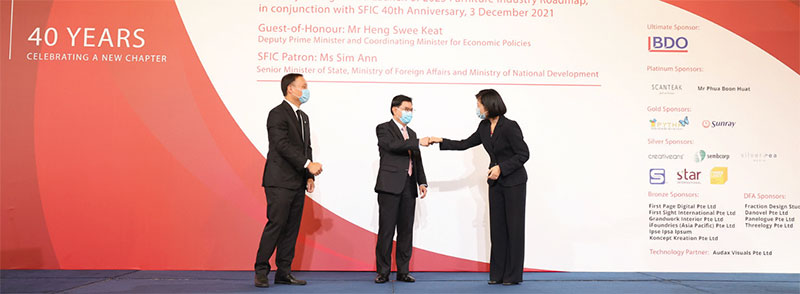
COVID-19 has disrupted our traditional trade fair/overseas mission calendar due to global restrictions on travel. We have since pivoted to using digital platforms to help our members internationalise and have largely switched from traditional outreach events to virtual modes which also has the benefit of a wider reach. While Digitalisation has always been in the pipeline in a pre-COVID environment, the pace of adoption and acceptance has accelerated as the industry and customers have few alternatives with restrictions in place.
The current pandemic does not appear to have reached the end of its course and countries like Singapore have adopted an endemic approach to manage the spread of the disease. Locally, the government has taken calibrated steps to slowly opening the economy. With the high vaccination rate in the country, Covid 19 cases are relatively well controlled and managed. With MICE events starting to take place again, we are buoyant that things will improve in the coming year. The need for physical interactions remained strong at least for our industry where long-term business relationships are hardly sealed over the internet. However, digital tools have also introduced efficiencies and buy-in have been encouraging. We foresee more of a hybrid strategy in terms of marketing and sales. With the world re-opening, the role of SFIC as a pillar to drive member companies for new opportunities and build new competencies amidst inflationary pressures will be more crucial than ever .
Sustainability has been the hot topic for many industries including ours. SFIC has partnered with fellow trade associations as The Singapore Business Federation (SBF) and Singapore Green Building Council (SGBC) to form a new Alliance for Action (AfA) on Sustainable Spaces to bring together stakeholders across different sectors to create and enhance sustainable spaces. SFIC’s sustainability push is a multi-dimensional approach that touches advocacy of better material use, raising awareness on the significance of indoor work quality on occupants’ health and wellbeing, and cultivating the awareness on the importance of sustainable spaces. These are key dimensions which will require greater communications to raise awareness, understanding and acceptance.
2021 has been a bumpy ride with varying effects from Covid-19 resurgence and business disruptions on different industry players. Economic uncertainties, geopolitics and climate change will be amongst the challenges to be closely watched.
The SFIC has just unveiled its 2025 Furniture Industry Roadmap which aims to leverage the opportunities presented around sustainability as catalysts of capability development, innovation and growth of the industry. Specifically, the 2025 roadmap aims to position the Singapore furniture industry as a regional bellwether for sustainable urban-living concepts that focus on future-oriented work-life integration.
The SFIC’s 2025 vision is to position the Singapore furniture industry as ‘the nexus of tomorrow’s work-life integration for sustainable urban living’. To achieve this, the industry roadmap will incorporate three key pillars – Market Agility, Urbanite-Centricty and Enterprise Adeptness – to guide SFIC members along.
First, the agility of the industry and its members remains its core thrust. Together with Enterprise Singapore and related stakeholders, SFIC will step up efforts to help members harness sustainability as a competitive advantage to capture new pockets of business opportunities quickly.
For emerging opportunities in new markets, industry members will be encouraged to move with greater speed. They should also deepen their presence in markets that have already been tapped.
Second, taking the urbanite-centricity theme further, the focus should be on developing solutions that meet the expectations of a post-Covid-19 work-life environment. To be able to do this better, industry players will need to better understand the new customer psyche and design sustainable urban living solutions for the future of living and work.
Another consideration involves the development of sustainability-driven furniture and furnishings amid consumers’ increased concern with regards to health and safety matters.
Further, Singapore furniture players have a particular advantage, given the republic’s high urbanisation rate of 100%. Singapore is thus a good test bed to model sustainable lifestyles for urban dwellers. Singapore furniture businesses can do their part by integrating circular systems underpinned by Singapore’s robust logistics and waste infrastructure, and by embracing innovative technologies to develop new materials and products.
Third, the upcoming roadmap aims to foster greater enterprise adeptness, i.e. cultivating stronger business mindset and skilfulness to enable members to gain a foothold in their respective arenas. Beyond the traditional supply chain, members can scale up by collaborating with non-conventional partners like those in the healthcare industry, urban planners, designers and green solutions providers.
Having just assumed the leadership of the ASEAN Furniture Industries Council (AFIC), SFIC will be working closely with the AFIC member countries to furher strengthen intra-ASEAN trade and its competitive advantage in the global market. Sustainability will be key on the journey ahead. The new AFIC leadership aims to achieve sustainability targets by adopting green business practices and grooming more regional green champions.
Despite the challenges of the pandemic and its many disruptive effects, the furniture industry has great potential as new spaces are constantly being created with a demand for furniture/furnishing products. Some industry players have even performed better with WFH practices propelling demand for quality furniture and the like. With more urbanization predicted in the near future, the opportunities in this industry will only increase.


Wissmann holdings, which is currently celebrating its 90th anniversary, was established in 1932 and over the years has gained a lot of experience in the global furniture industry, including product development, manufacturer, supplier development and the establishment of a quality control system in several centers around the world.
The group of companies has proven experience working with furniture manufacturers in Europe as well as the Far East with more than 80 modern and reliable factories handling a wide range of furniture categories.
Our group operates in the field of retail, wholesale, projects and international trade in the field of furniture. The furniture brands in the Wissmann Group include furniture for all rooms in the house except kitchens and include: dining tables, seating systems, bedroom furniture, children’s rooms, baby furniture, wall systems, wardrobes, carpets, complementary accessories and furniture for projects. The products of all the group’s brands are available in dozens of stores and also on the websites of all the brands in Wissmann Group.
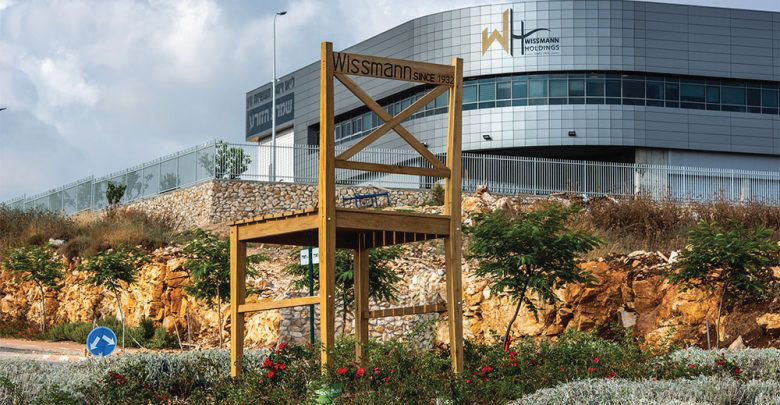
It has been about two years of dealing with the covid-19 in the world and now we can say that Wissmann Holdings brands actually flourished during the covid-19 period due to the huge demand created while customers spend a lot of time at homes and they just need furniture for all rooms , that is why we have strengthened our digital marketing presence and encouraged consumers to purchase online.
Our marketing strategy during the covid-19 period has not actually changed but the tactics have changed in such a way that most of the efforts have been directed to advertising the online store because of the overconsumption that was when customers spend a lot of time at home and exposed to online information.

From the customers’ point of view, this is a period of uncertainty in every aspect of life, in health, economic and other general aspects. In such a challenging period we see that customers trust only reliable companies with a long tradition and reputation. And in order to learn and respond accurately we use osint tools etc. in order to learn about consumer behavior from the early stages of the global epidemic and the impact on consumption habits. We analyze the type of products purchased, price ranges, geographical locations and understand that during the epidemic we were able to take advantage of opportunities and reach new customers who believe in the group’s brands. Data show that as in the subprime mortgage crisis, when the market is characterized by uncertainty, customers only trust reliable companies that will ensure that the products are delivered on time without risking their money.
Those who managed to survive the difficult period can expect continued prosperity because life experience shows that after an epidemic or war there is always prosperity in business in most industries and especially in furniture and home design so our forecast for 2022 is to continue the growth trend of all Wissmann holdings activities.

The covid-19 crisis has other aspects that we have witnessed in recent months, the global supply chain is in crisis, factories around the world have closed for a while, shipping prices are rising excessively, prices of goods and services continue to rise and the final consumer is hurt. Therefore the big challenge for us is to take care of our customers and for this purpose we have made accurate production planning, we increase the production and distribution system in accordance with the challenges so that our consumers will not be harmed and all in order to continue to deliver the products on time and with the quality that characterizes us in all the group’s brands.
A strong business survives and even grows in difficult times, the covid-19 crisis has caused a dilution of manufacturers and retailers in the global furniture market and not only, the companies in the furniture and home design industry that managed to overcome the crises and challenges brought by the global epidemic, will continue to flourish Because they knew how to run the business properly and knew how to respond quickly and efficiently to real-time events on the go.